
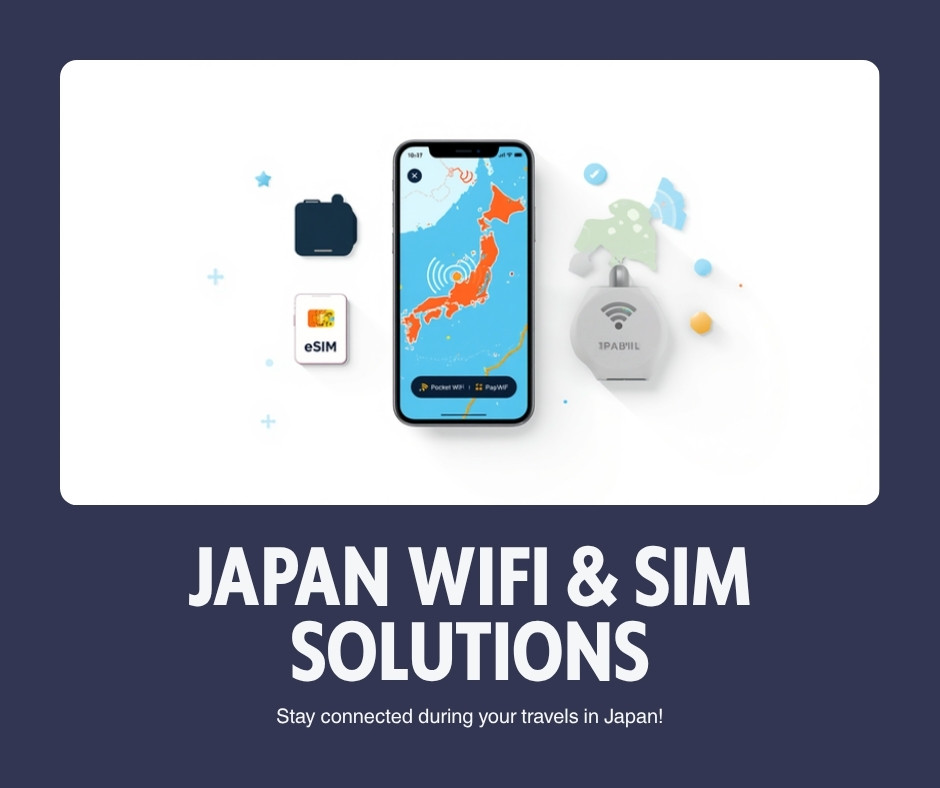
You will need internet access from the moment you land. Google Maps for navigation, Google Translate for menus, LINE for communicating with hosts, train apps, restaurant reservations — Japan in 2026 is eminently navigable with a phone and data connection, but the moment you lose that connection, the city becomes significantly harder.
Tourists visiting Japan in 2026 have three main connectivity options: eSIM, pocket WiFi, and a physical SIM card. Each has a clear best use case. This guide cuts through the noise and tells you which one is right for your trip.
1. The Three Options Explained
A digital SIM loaded onto your phone via QR code. No physical card needed. Buy before you leave home, activate on arrival. Works on iPhone XS or later and most 2020+ Android phones.
A small battery-powered device that creates a personal WiFi hotspot. Multiple devices connect simultaneously. Pick up at the airport or have it delivered to your hotel. Must be kept charged and with you.
A traditional SIM card that replaces your home SIM in your phone. Full coverage on Japanese networks. Best for older phones or those without eSIM support.
2. eSIM: Best for Solo Travelers and Couples
For the majority of solo travelers and couples with modern smartphones, eSIM is the clear recommendation in 2026. The setup takes five minutes at home before your flight, and you land in Japan with data already active.
How it works:
- Buy an eSIM plan from a provider (Airalo, Holafly, Saily, Nomad, Klook eSIM)
- Receive a QR code by email
- On your phone: Settings → Cellular → Add eSIM → scan the QR code
- Set the eSIM as your data line for Japan; keep your home SIM active for calls
- Land in Japan, turn off airplane mode, and data connects automatically
Cost comparison:
| Provider | Data | Duration | Approx. Cost |
|---|---|---|---|
| Airalo | 1GB | 7 days | ~¥700 (¥5 USD) |
| Airalo | 10GB | 30 days | ~¥2,700 |
| Holafly | Unlimited | 15 days | ~¥3,500 |
| Saily | 5GB | 30 days | ~¥1,800 |
Not all phones support eSIM. iPhone XR and earlier do not. Many budget Android phones do not. Before buying an eSIM, confirm your phone model supports eSIM and that your device is unlocked (not carrier-locked to a single network). Check your settings under "Cellular" or "Mobile Data" — if there is an "Add eSIM" option, you are compatible.
3. Pocket WiFi: Best for Groups and Families
If you are traveling with two or more people, pocket WiFi often wins on economics. One device shares data across up to 10 connected phones and tablets, splitting the cost.
Cost example — 4 people, 14-day trip:
- Japan Wireless unlimited plan: ~¥9,520 total (¥680/day) = ¥2,380 per person
- 4 individual eSIMs at ¥3,500 each = ¥14,000 total
- Pocket WiFi saving: ~¥4,480 for the group
Downsides of pocket WiFi:
- Another device to carry and charge
- If the battery dies mid-day, everyone loses connectivity simultaneously
- If someone in the group separates, they lose internet access
- Return process required — missing the return can incur fees
4. Physical SIM Card: Best for Older Phones
If your phone does not support eSIM and pocket WiFi does not suit your travel style, a physical SIM card is a reliable fallback. It works exactly like your home SIM — insert, activate, and you have a Japanese phone number and data plan.
- Where to buy: Airport counters (IIJmio, OCN Mobile, b-mobile), some convenience stores, electronics shops (Yodobashi Camera, Bic Camera)
- Cost: ¥2,300–¥3,500 for a 14–30 day plan with 5–20GB data
- Setup: Most tourist SIMs come pre-activated. Insert the card, restart your phone, and data connects
- Limitation: Data-only SIMs (the most common tourist option) do not provide a Japanese phone number for voice calls
5. Free WiFi Options in Japan
Japan has extensive free WiFi available in tourist areas — but it is unreliable enough that you should not depend on it as your primary connectivity.
- 7-Eleven, FamilyMart, Lawson: Free WiFi in every branch — requires registration on first connection
- McDonald's: Free WiFi, registration required
- Starbucks: Free WiFi with time limits
- Most major train stations: Free WiFi zones at ticket gate areas
- Tourist information centers: Free WiFi at city tourist offices
6. Which Should You Choose?
| Your situation | Best option |
|---|---|
| Solo traveler with eSIM-compatible smartphone | eSIM (cheapest, most convenient) |
| Group of 3+ people with any smartphones | Pocket WiFi (split the cost) |
| Older phone without eSIM support | Physical SIM card |
| Budget traveler, short trip (3–4 days) | eSIM 1–3GB plan |
| Heavy data user / remote worker | Pocket WiFi unlimited plan |
Frequently Asked Questions
Q: Can I buy a SIM card at Japanese airports?
Yes. All major Japanese international airports (Narita, Haneda, Kansai, Chubu) have SIM card and pocket WiFi rental counters in the arrivals area. Providers include IIJmio, b-mobile, OCN Mobile, and Japan Wireless. You can also collect a pre-ordered SIM or pocket WiFi at dedicated counters after clearing customs.
Q: Does my eSIM work on the Shinkansen?
Yes, Japanese networks cover the shinkansen corridors. You may experience brief dead zones in tunnels, but connectivity resumes immediately after. Speeds are generally excellent on the bullet train routes.
Q: What if I need to make phone calls in Japan?
Most tourist SIMs and eSIMs are data-only. For calls, use WhatsApp, FaceTime, LINE, or Google Voice over your data connection. If you genuinely need a Japanese phone number (for making reservations at restaurants that require a local number), some SIM providers offer voice add-ons for an additional cost.
Q: Is there 5G coverage for tourists in Japan?
Yes — Japan's three major carriers (NTT Docomo, SoftBank, au/KDDI) all offer 5G coverage in major cities. Most tourist eSIM and SIM plans run on 4G LTE with optional 5G access. In Tokyo, Osaka, and Kyoto, speeds are fast enough that the 4G/5G distinction rarely matters for typical tourist use.
Conclusion
Getting connected in Japan is straightforward in 2026. For most tourists, the decision is simple: if you have a modern smartphone and are traveling alone or as a couple, buy an eSIM before you fly. If you are a group of three or more, rent pocket WiFi at the airport and split the cost. Either way, the investment is small — a reliable internet connection in Japan pays for itself on the first day of navigation and translation alone.
Related: Suica & PASMO Guide · Cash vs Card in Japan · Japan Airport Guide
Sources: Japan Wireless — WiFi vs eSIM vs SIM 2026 · Saily — eSIM vs Pocket WiFi Japan 2026