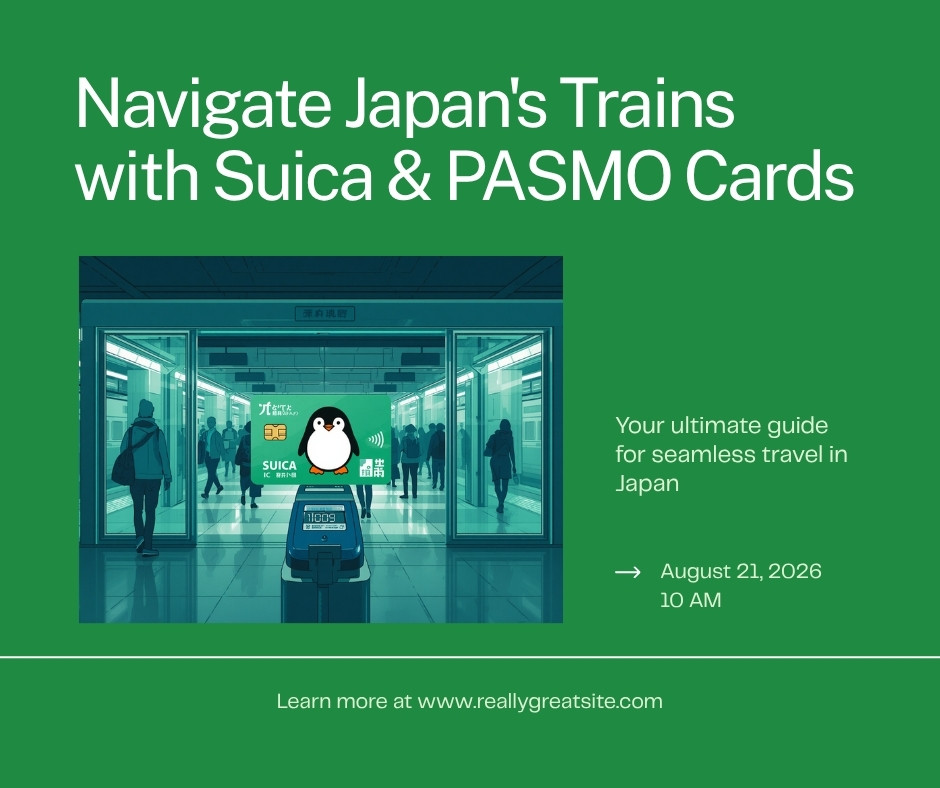
If there is one thing to sort out the moment you land in Japan, it is getting an IC card. These small contactless cards — the most well-known are Suica (スイカ) and PASMO (パスモ) — let you ride almost every train, subway, and bus in Japan by simply tapping a reader. No fumbling with fare maps, no buying tickets for each journey, no coins.
Beyond transport, the same card works at convenience stores, vending machines, lockers, taxis, and hundreds of shops across the country. In 2026, getting one before you leave the airport is one of the smartest moves you can make as a tourist in Japan.
1. Suica vs PASMO: What Is the Difference?
Suica is issued by JR East (Japan Railways East). PASMO is issued by the Tokyo metro and private rail companies. For tourists, they work identically — both can be used on all IC-compatible trains, buses, and shops across Japan. The choice between them is mostly about where you pick one up.
| Card | Issued by | Where to buy | Deposit |
|---|---|---|---|
| Welcome Suica | JR East | Haneda T2, Narita T1/T2, Tokyo Station | ¥0 (no deposit) |
| Tourist PASMO | PASMO Passport | Narita Keisei stations, Haneda Keikyu stations | ¥0 (no deposit) |
| Regular Suica/PASMO | JR East / PASMO | Any ticket machine at major stations | ¥500 (refundable) |
| Mobile Suica (iPhone) | JR East | Apple Wallet on iPhone | ¥0 |
2. How to Get an IC Card at the Airport
The best time to get your card is the moment you clear customs. All major airports have IC card counters or ticket machines near the arrival exits.
- Narita Airport: Welcome Suica machines at Terminal 1 and Terminal 2. Tourist PASMO at Keisei Terminal 1 and 2 stations inside the airport.
- Haneda Airport: Welcome Suica machines at Terminal 2. Tourist PASMO at Keikyu line Terminal 1/2 and Tokyo Monorail Terminal 3.
- Kansai International Airport (Osaka): ICOCA (the Kansai equivalent, works identically) at JR West ticket machines in the arrivals area.
The machines have English interfaces. Select the card type, insert cash (¥1,000 minimum), and your card is ready to use within two minutes.
3. How to Use Your IC Card on Trains and Buses
Using an IC card is one of the most satisfying parts of travel in Japan. The system is fast, reliable, and works on virtually every public transport network in the country.
- At train gates: Hold your card or phone over the blue IC symbol on the gate reader. A beep confirms entry. Tap again when exiting. The system calculates the exact fare between your entry and exit stations and deducts it automatically.
- On buses: Tap when boarding (and sometimes again when exiting, depending on the bus system). The display above the reader shows your remaining balance.
- Minimum balance: Keep at least ¥500 on the card at all times to avoid being blocked at exit gates.
- Low balance warning: If your balance drops below the fare needed, the gate will not open. Go to a recharge machine or convenience store counter before attempting to exit.
IC cards cover local and rapid trains but NOT most shinkansen (bullet train) fares. For shinkansen, you need a separate ticket or Japan Rail Pass. The exception is the Tokaido Shinkansen, which accepts IC card payment via the IC-linked ticketing system, but regular tapping does not work for bullet trains.
4. How to Charge Your IC Card
Keeping your card topped up is easy. You can add balance in multiple places:
The most common option. Look for チャージ (charge) buttons or machines with an IC card logo. Insert your card and cash (¥1,000, ¥2,000, ¥5,000, or ¥10,000 notes).
Tell the cashier "charge" and hand over your card and cash. Works at 7-Eleven, FamilyMart, Lawson, and most other convenience chains.
Add balance directly in Apple Wallet using your overseas credit card. No cash needed — top up from anywhere in the world.
There is no expiry on the balance. Money loaded onto your card stays there indefinitely (though Welcome Suica itself expires 28 days after first use — balance is forfeit if unused).
5. Beyond Transport: Where IC Cards Work
This is where IC cards genuinely surprise tourists. The same card you use for trains also works at:
- Convenience stores: 7-Eleven, FamilyMart, Lawson — tap at the register for any purchase
- Vending machines: The vast majority of vending machines in Japan now accept Suica/PASMO
- Coin lockers: Station lockers with IC card payment (no coins needed)
- Airport and station kiosks: Food, books, coffee, souvenirs
- Some taxis: Many Tokyo taxis now accept IC cards via a card reader in the back seat
- Some supermarkets and fast food chains
6. Coverage: Where Does Suica/PASMO Work in Japan?
All major IC cards in Japan — Suica, PASMO, ICOCA, Kitaca, Toica, Manaca, PiTaPa, Sugoca, Nimoca, Hayakaken — share a mutual interoperability system. This means your Tokyo Suica works in Osaka, Kyoto, Nagoya, Hiroshima, Sapporo, Fukuoka, and almost every city with rail or bus transport.
Exceptions do exist — some rural lines and ferry services may not accept IC cards — but for the overwhelming majority of tourist travel across Japan, a single Suica covers everything.
Frequently Asked Questions
Q: Do I need both Suica and PASMO?
No. Get one — either will work on all IC-compatible transport in Japan. The difference is which company issues it, not where it works. Welcome Suica is the most tourist-friendly option because it is sold at the airport with no deposit and an English interface.
Q: Can I use my Suica outside of Tokyo?
Yes. Suica works across Japan wherever the IC card network is accepted — including Osaka, Kyoto, Nagoya, Fukuoka, Sapporo, and more. The mutual interoperability agreement covers virtually all urban transport in Japan.
Q: What if my IC card balance runs out at a gate?
Go to a fare adjustment machine (精算機, seisan-ki) near the exit gates — they are in every station. Insert your card and pay the difference to exit. Do this before attempting to leave the paid area, or you will not be able to pass through the gate.
Q: Can Android users get a mobile Suica?
Yes, via the Suica app on Google Pay-compatible Android devices. The setup process is slightly more involved than on iPhone, but the functionality is identical once set up.
Q: What happens to unused balance when I leave Japan?
Welcome Suica: the card expires 28 days after first use and unused balance cannot be refunded. Regular Suica: take the physical card to a JR East ticket counter at a major station to get your ¥500 deposit back plus any remaining balance (minus a ¥220 handling fee if balance exceeds ¥220).
Conclusion
Japan's IC card system is one of the most elegant pieces of public infrastructure in the world. One tap replaces a hundred individual ticket purchases, one card covers every city you visit, and the same card pays for your coffee, lunch, and locker. Get a Welcome Suica at the airport before you do anything else — your Japan trip will be noticeably smoother for it.
Related: Cash vs Card in Japan · Japan Train Etiquette Guide · Coin Lockers in Japan
Sources: NAVITIME Japan — Suica & PASMO Guide 2026 · Truly Tokyo — Welcome Suica Guide