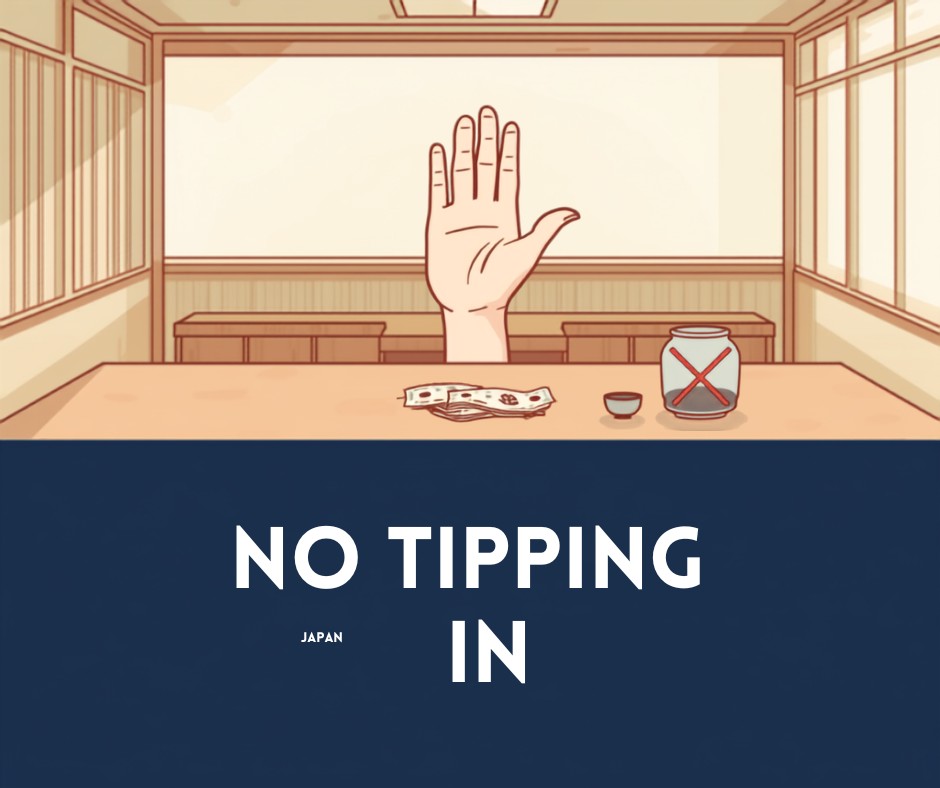
Your meal was extraordinary. The ramen arrived in under three minutes, the broth was perfect, and the staff refilled your water without being asked. Naturally, you reach for extra cash to leave on the table as a thank you. In most of the world, this is a kind gesture.
In Japan, it will cause a minor panic.
Japan has no tipping culture — not at restaurants, not in taxis, not at hotels, and not for tour guides. Understanding why changes how you experience the country, and knowing what to do instead lets you express genuine gratitude in a way that actually lands.
1. What Is Omotenashi?
Omotenashi (おもてなし) is the Japanese philosophy of wholehearted hospitality. It goes beyond service — it is the anticipation of what a guest needs before they know they need it, delivered without expectation of reward.
This is the foundation of why tipping does not exist in Japan. Service workers take pride in performing their role to the highest standard because that is the job, not because a tip might arrive at the end. The payment structure reflects this: workers receive fair, stable wages, and the bill you receive already includes full compensation for the service you received.
This is not universal — there are nuances — but it explains why the default in Japan is to pay exactly what the bill says and leave without anything extra on the table.
2. Tipping Across Specific Situations
| Situation | Tip? | Notes |
|---|---|---|
| Restaurants (casual) | Never | Pay the bill, say thank you, leave |
| Restaurants (high-end) | Never | A service charge may be added to the bill (10–15%) but no additional tip expected |
| Ramen, soba, udon counters | Never | Pay at the vending machine or counter; no tipping process exists |
| Taxis | Never | Pay exactly the meter amount; rounding up is not expected |
| Hotel housekeeping | Never | No envelope system; rooms are cleaned as part of hotel operations |
| Hotel bellhop/porter | Never | Carrying bags is part of the service; no tipping expected |
| Hair salons / barbers | Never | Pay the posted price; no gratuity line on receipts |
| Spa / massage (hotel) | Never | Service is included in the price you pay |
| Private tour guides | Occasional exception | See section 4 below |
The staff will likely run after you to return the money, assuming you forgot your change. This creates an awkward situation for everyone. If you insist it is intentional, the staff may still decline. Save yourself the confusion — pay exactly what is on the bill.
3. Service Charges: The Fine Print
Some upscale restaurants, resort hotels, and ryokan (traditional Japanese inns) add a service charge (サービス料, sabisu-ryo) of 10–15% to the bill. This is visible on the itemized receipt and covers staff compensation. No additional tip is expected or appropriate on top of this.
When a service charge applies, the receipt will show it clearly. If you are unsure whether a charge is a service fee or a tax, ask — staff at tourist-oriented establishments generally speak enough English to explain.
4. The One Exception: Private Guides
Japan-based private tour guides and interpreters who work with international tourists occupy a different space. Many operate independently or through international booking platforms where tipping is a cultural norm for their clientele. Some do accept tips, though it is still not an expectation.
If you genuinely want to tip a private guide:
- Prepare a clean envelope with new or clean bills
- Present it at the end of the tour with both hands and a slight bow
- An appropriate amount: ¥1,000–¥3,000 for a half-day, ¥3,000–¥5,000 for a full day
- Say "This is a small token of appreciation" so the intent is clear
5. How to Show Genuine Appreciation in Japan
The good news: Japanese culture has its own rich vocabulary of appreciation that means more to service workers than cash on the table.
Spoken after finishing a meal (ご馳走様でした). It means "Thank you for the feast." It is the standard closing phrase at any restaurant and is deeply appreciated when said by foreign visitors.
A brief bow of the head and a sincere "arigato gozaimashita" (thank you very much) goes further than any monetary tip in expressing genuine gratitude.
A positive Google Maps or TripAdvisor review in English helps the business reach international tourists. Many small restaurants and hotels understand its value more than a cash tip.
If you stay at a ryokan or visit a place multiple times, a small gift (omiyage) from your home country — wrapped neatly — is a culturally resonant gesture of appreciation.
6. What About Ryokan Stays?
Traditional Japanese inns (ryokan, 旅館) offer a highly personalized experience — private meals served in your room, assistance with yukata, and attentive nakai-san (room attendants). This is the situation where the tipping question most often arises for tourists.
The answer is still: no tip expected. Ryokan prices are inclusive of all services, and the nakai-san's attentiveness is a professional expression of omotenashi, not a bid for additional compensation. Say thank you warmly, leave the room tidy, and follow the house customs — that is the correct form of appreciation.
Frequently Asked Questions
Q: What if I tip and the staff refuses to accept it?
This is common. Politely accept the refusal, smile, and say "arigatou gozaimashita." Do not push. The refusal is not unfriendly — it is the culturally correct response to a practice that does not exist in Japan.
Q: Is there a tip line on credit card receipts in Japan?
No. Japanese credit card receipts do not have a tip or gratuity line. You sign for the exact amount of the bill.
Q: Do Japanese workers earn enough without tips?
Yes — Japan's wage structure does not rely on tips. Restaurant and hotel workers receive their agreed salary regardless of tips. Service charges at higher-end establishments are explicitly distributed to staff. The absence of tipping is not a sign of low wages; it is a different system.
Q: What about international hotel chains (Hilton, Marriott, etc.) in Japan?
Even at international chains operating in Japan, the local no-tipping norm applies. Staff are trained in the local custom and generally will not expect tips. If in doubt, the safe approach is to pay the bill and express verbal thanks.
Conclusion
Japan's no-tipping culture is one of the most refreshing aspects of travel in the country. You receive outstanding service — one of the best in the world — pay exactly what is written on the bill, and express your appreciation through words and gestures rather than cash. Learning a few phrases like "gochisosama deshita" and "arigatou gozaimashita" will create more genuine human connection with the people who serve you than any amount of money left on the table.
Related: Cash vs Card in Japan · Japan Izakaya Guide · Sushi in Japan: Etiquette Guide
Sources: JNTO — Tipping in Japan · Boutique Japan — Tipping Guide