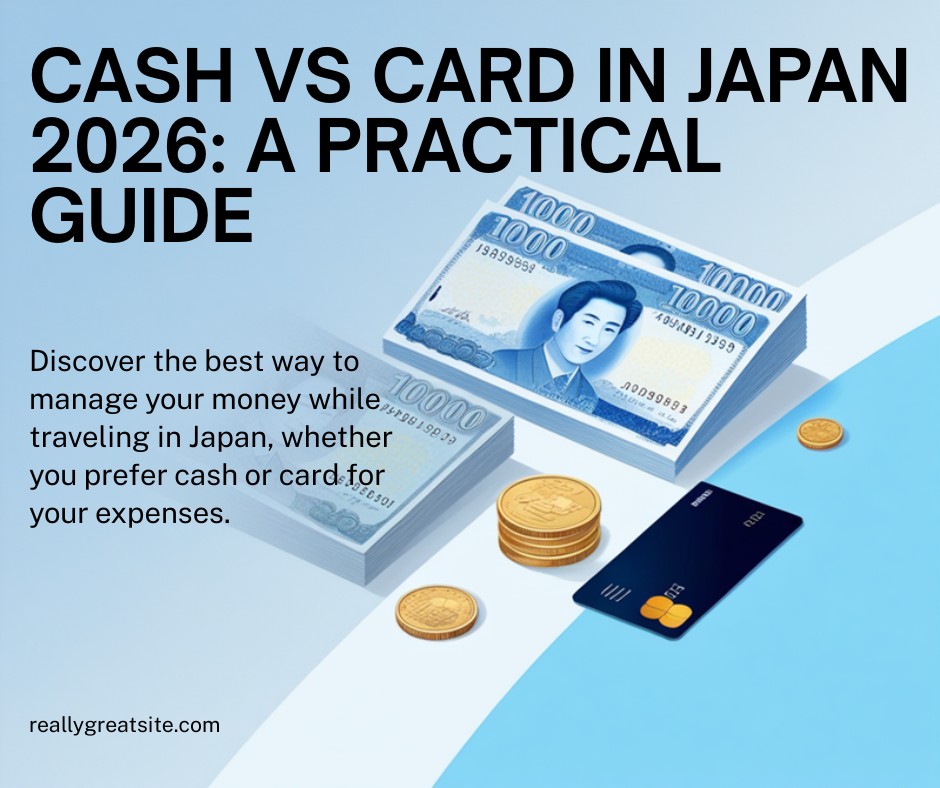
Japan's reputation as a cash-heavy society is changing — but it has not changed completely. In 2026, the major chains, tourist areas, and convenience stores across Japan accept cards. But the neighborhood ramen shop, the shrine entrance, the festival food stall, and the vending machine outside your hotel still want yen.
The smart tourist in Japan in 2026 carries both: a moderate amount of cash for the situations that require it, and a credit card for larger purchases. Here is the honest breakdown of where each works, how much to carry, and how to get yen without paying unnecessary fees.
1. Where Cards Work in Japan (2026)
Cashless payment has expanded significantly across Japan in recent years. The following accept credit and debit cards reliably:
Convenience stores (7-Eleven, FamilyMart, Lawson), department stores, major supermarkets (AEON, Ito-Yokado), chain restaurants (McDonald's, Yoshinoya, Matsuya), hotels and ryokan, most tourist-area shops, pharmacies (Matsumoto Kiyoshi, Welcia), Uniqlo, MUJI.
All trains and buses, vending machines, most convenience stores, coin lockers, some taxis. An IC card loaded via credit card bridges the gap between card and cash for small daily purchases.
Rapidly expanding. Major retailers, many restaurants, and transportation hubs now accept tap-to-pay via Visa/Mastercard contactless. Works where you see the contactless symbol.
2. Where You Still Need Cash
Despite the cashless push, these situations reliably require yen in 2026:
| Situation | Why cash | Typical amount |
|---|---|---|
| Small local restaurants (ramen shops, soba counters, izakayas) | Many family-run places have never installed card readers | ¥800–2,000 per meal |
| Shrine and temple offerings | Saisen (offering) boxes accept coins only | ¥5–¥100 |
| Festival food stalls (yatai) | All street food vendors are cash-only | ¥2,500–4,000 per evening |
| Traditional market stalls | Flea markets, Tsukiji outer market, Nishiki market vendors | ¥500–5,000 |
| Rural and countryside | Outside major cities, card acceptance drops sharply | Varies |
| Some onsen / public baths | Neighborhood sentos often cash-only | ¥500–2,000 |
| Coin lockers (older stations) | Not all lockers accept IC cards or cards | ¥300–900 |
The most common tourist mistake in Japan: arriving at a popular restaurant, eating a full meal, and then discovering cash-only on the register. Always confirm payment methods before ordering at smaller restaurants, especially those without English menus or tourist signage. A quick "card wa tsukaemasu ka?" (Can I use a card?) saves the embarrassment.
3. How Much Cash Should You Carry?
| Trip type | Recommended cash budget | Notes |
|---|---|---|
| Tokyo, 3–4 days (mostly tourist areas) | ¥15,000–¥25,000 | Major city, good card acceptance |
| Osaka/Kyoto, 4–5 days | ¥25,000–¥40,000 | More traditional areas, more cash required |
| Rural Japan / countryside (per week) | ¥40,000–¥60,000 | Card acceptance drops significantly outside cities |
| Day with a festival or market | Add ¥5,000–10,000 | All stalls cash only |
| Day at a famous shrine/temple complex | Add ¥2,000–3,000 | Entrance fees, offerings, omikuji |
4. How to Get Yen Without Paying Excessive Fees
Not all Japanese ATMs accept foreign cards. Knowing which ones do — and which credit card to use — saves real money.
Accepts Visa, Mastercard, American Express, UnionPay, and most international cards. Available 24/7. One of the most reliable for foreign cards. English interface available.
At post offices nationwide. Accepts most foreign Visa and Mastercard. Hours match post office hours (typically 9 a.m.–5 p.m. on weekdays; some open Saturdays).
Found inside AEON supermarkets and some malls. Accepts international cards and is often open 24/7. Reliable English interface.
ATMs from Japanese banks like Mizuho, MUFG, SMBC often do not accept foreign cards, or only accept them during limited hours. Do not rely on these.
5. Currency Exchange: Airport vs City
Where you exchange matters:
- Narita/Haneda airport counters: Convenient but rates are typically 2–4% worse than city rates. Use them for initial cash to cover transport (¥3,000–5,000) but get the rest in the city
- Post offices in city: Often the best rates for cash exchange, and reliable English service at major branches
- 7-Eleven ATM with Wise/Revolut: Best overall approach — withdraw yen at the interbank rate with minimal fees
- Hotel exchange desks: Convenient but rates are usually 3–5% worse than ATMs — a last resort
- Avoid: Currency exchange booths advertising "zero commission" — their spread (the gap between buy and sell rates) is where the profit hides
6. Recommended Payment Strategy for Japan 2026
Based on how Japan actually works in 2026, the optimal tourist setup is:
- IC card (Suica/PASMO) — loaded with ¥3,000–5,000 — for all train, bus, convenience store, and vending machine purchases
- Visa or Mastercard contactless (preferably with no foreign transaction fee) — for hotels, department stores, chain restaurants, and pharmacies
- ¥20,000–30,000 cash — for small restaurants, markets, festival stalls, shrines, and rural areas
- 7-Eleven ATM access — via Wise or a zero-fee international card — for replenishing cash as needed
This combination covers approximately 95% of tourist spending in Japan without over-relying on any single method.
Frequently Asked Questions
Q: Can I use American Express in Japan?
Amex is accepted at major hotels, department stores, and tourist-area restaurants, but far less commonly at smaller establishments than Visa or Mastercard. If Amex is your only card, carry more cash than usual as a backup.
Q: Do Japanese banks charge fees for international ATM withdrawals?
7-Eleven and Japan Post ATMs typically charge ¥110–220 per withdrawal. Your home bank may add its own fee on top. Using a card with no foreign ATM fees (Wise, Charles Schwab, Revolut) eliminates the home bank charge; you only pay the local machine fee.
Q: Is ¥10,000 a lot in Japan?
¥10,000 is Japan's largest banknote (roughly $65–70 USD in 2026). It covers a full day of meals at casual restaurants, local transport, and some shopping. Keep a few in reserve. Very small businesses may not be able to break a ¥10,000 note easily — carry some ¥1,000 notes for small purchases.
Q: Should I exchange money before leaving for Japan?
Not necessary and often not the best rate. Airport exchange at your home country is convenient but expensive. A better approach: bring a small amount of yen from home for immediate airport expenses, then use a 7-Eleven ATM in Japan for the rest.
Conclusion
Japan in 2026 rewards the tourist who carries a moderate cash float alongside a contactless card. The country is moving toward cashless, but the soul of the experience — the neighborhood izakaya, the festival yatai, the temple offering box — still runs on yen. Treat cash as your base layer and cards as your efficiency layer, and you will never be stuck.
Related: Suica & PASMO IC Card Guide · Tipping in Japan · Tax-Free Shopping in Japan
Sources: Kawaraban Japan — Cash vs Card Guide · Japan Activity — Money Guide 2026