
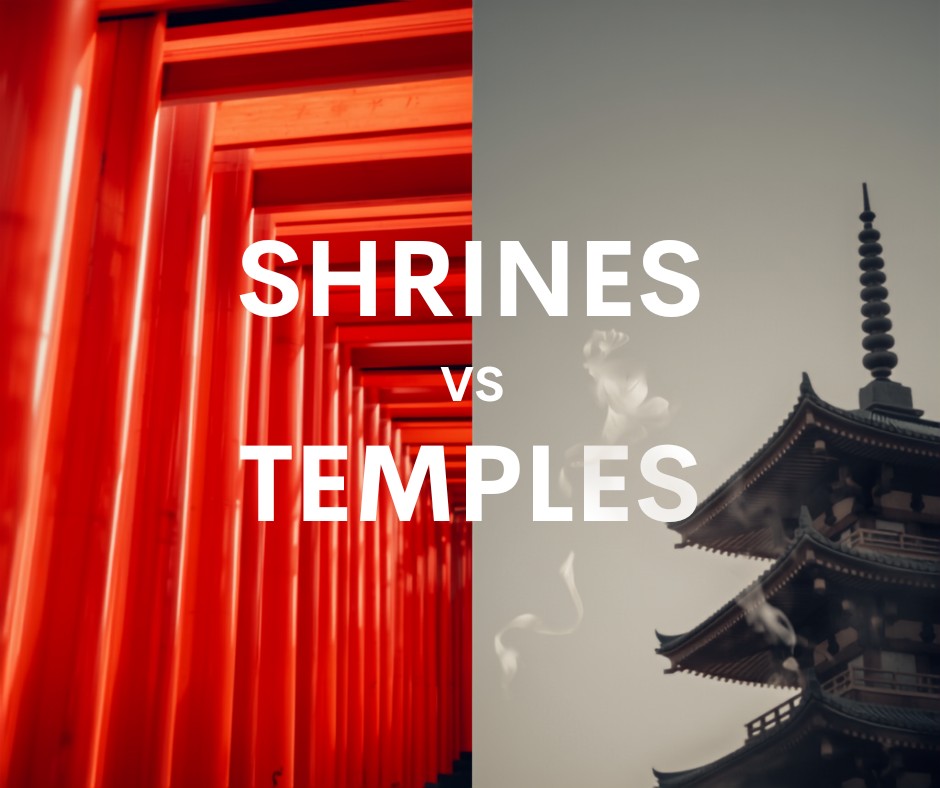
You are standing at the entrance to a beautiful Japanese sacred site. Is it a shrine or a temple? The distinction matters — not just for cultural understanding, but because the etiquette is different, the architecture tells a completely different story, and what you can do there varies significantly.
The confusion is understandable. Japan has roughly 88,000 shrines and 77,000 temples, and some historic sites contain elements of both on the same grounds. But once you know the two visual signatures — the torii gate and the sanmon gate — you will never confuse them again.
1. The Quick Test: What Are You Looking At?
You can identify a shrine or temple in seconds using these signals:
⛩️ Shinto Shrine (神社, jinja)
- Torii gate at the entrance (two posts, two crossbeams — often vermilion)
- Name ends in "-jinja," "-taisha," "-jingu," or "-miya"
- Guardian animals (foxes, lion-dogs)
- Sacred rope (shimenawa) on trees and pillars
- No incense
- No cemetery
- No Buddha statues
🏯 Buddhist Temple (寺, tera/ji)
- Sanmon gate (large wooden gate with roof — looks like a small building)
- Name ends in "-dera," "-ji," or "-in"
- Buddha or Bodhisattva statues
- Incense (the smell is the quickest giveaway)
- Often a multi-storey pagoda
- Cemetery may be on grounds
2. The Religious Difference: Shinto vs Buddhism
Shrines are Shinto. Shinto (神道, "way of the gods") is Japan's indigenous religion, focused on kami (神) — spirits or divine forces that inhabit natural phenomena, places, and ancestors. It has no single founder, no canonical text, and no afterlife theology. Shrines mark places where kami dwell.
Temples are Buddhist. Buddhism arrived in Japan from China and Korea in the 6th century CE, bringing with it a rich tradition of scripture, meditation, and clerical hierarchy. Temples house Buddha statues, monks, and ritual objects from the Buddhist tradition.
For most of Japanese history, Shinto and Buddhism coexisted and intertwined — many sites had both deities on the same grounds (shinbutsu-shugo). The two were only formally separated by government order in 1868. As a result, some historic complexes still blur the lines.
3. The Torii Gate: Japan's Most Recognized Symbol
The torii (鳥居) is arguably the most recognized symbol of Japan in the world. Its purpose: marking the boundary between the ordinary world and the sacred space of a Shinto shrine. When you pass through a torii, you are entering the realm of the kami.
Key torii facts for tourists:
- The classic vermilion color represents vitality and the power to ward off evil — though torii can also be unpainted wood, stone, or concrete
- The Fushimi Inari Taisha in Kyoto is famous for its thousands of torii gates — all donated by companies and individuals as offerings to Inari, the kami of rice and business
- Bow when passing through a torii gate — a brief nod of the head is the correct etiquette, though many Japanese do this reflexively and tourists are not expected to know
- Walk to the side, not the center — the center of the path leading to the main shrine hall is traditionally reserved for the kami
4. Shrine Etiquette: Step by Step
- Pass through the torii — bow briefly before entering
- Purify your hands at the temizuya (手水舎) — the stone water basin near the entrance. Use the ladle to pour water over your left hand, then right hand, then cup water in your hand to rinse your mouth (optional at most tourist shrines now)
- Approach the main hall (haiden) and toss a coin into the offering box — any amount, though ¥5 coins (go-en, meaning "good connection") are traditional
- Ring the bell (if there is one) by pulling the rope — this alerts the kami to your presence
- Bow twice, clap twice, bow once — this is the standard shrine prayer sequence (ni-rei ni-hakushu ichi-rei)
- Pray silently, then step back
5. Temple Etiquette: Step by Step
- Pass through the sanmon gate — a brief bow is appropriate
- If incense is available, you may light a stick and waft the smoke over yourself — it is believed to purify and heal
- Approach the main hall — place a coin in the offering box
- Bow once and press your palms together (gassho) — this is the Buddhist prayer gesture, not the shrine two-clap sequence
- Pay your respects silently, then step back
| Element | Shinto Shrine | Buddhist Temple |
|---|---|---|
| Entrance gate | Torii (two posts) | Sanmon (roofed gate) |
| Prayer gesture | 2 bows, 2 claps, 1 bow | 1 bow, palms together |
| Water purification | Yes (temizuya) | Varies |
| Incense | No | Often yes |
| Deity statues | No (kami are invisible) | Yes (Buddha, Kannon) |
| Amulets sold | O-mamori, ema, omikuji | O-mamori, prayer beads |
6. Must-Visit Shrines and Temples in Japan
⛩️ Famous Shrines
- Fushimi Inari Taisha (Kyoto) — thousands of torii gates on a forested mountain
- Meiji Jingu (Tokyo) — serene forest shrine in central Tokyo
- Ise Jingu (Mie) — Japan's most sacred shrine, rebuilt every 20 years
- Itsukushima Shrine (Hiroshima) — the floating torii gate on the sea
🏯 Famous Temples
- Senso-ji (Tokyo, Asakusa) — Tokyo's oldest temple, always crowded
- Kinkaku-ji (Kyoto) — the Golden Pavilion
- Todai-ji (Nara) — home to Japan's largest bronze Buddha
- Ryoan-ji (Kyoto) — famous rock garden temple
Frequently Asked Questions
Q: Can tourists pray at shrines and temples?
Yes. Non-Japanese visitors are welcome to participate in the standard rituals — purifying hands at the water basin, tossing a coin, bowing. Nobody will stop you from approaching the main hall and praying. The atmosphere is generally quiet and respectful; match that and you will be welcome.
Q: What is omikuji?
Omikuji (おみくじ) are fortune slips, available at both shrines and temples for ¥100–200. Draw a stick from a tube or pull a slip from a box to receive a fortune ranging from great blessing (dai-kichi) to great curse (dai-kyo). If you receive a bad fortune, fold it and tie it to a designated tree or wire rack at the site — leaving the bad luck behind.
Q: What is an ema?
Ema (絵馬) are small wooden plaques, primarily sold at shrines, on which visitors write wishes or prayers and hang them on a dedicated rack. They are shaped like a house with a pointed roof and often feature the motif of the local shrine. A classic and personal souvenir or offering.
Q: Is it disrespectful to visit a shrine or temple as a tourist?
Not at all. Shrines and temples in Japan are simultaneously active places of worship and welcoming public spaces. Tourists visit them constantly and are expected. Simply behave quietly, follow the basic etiquette, and be mindful near areas marked as restricted or where active rituals are taking place.
Q: How do I know if the site is free to enter?
Many shrines are free. Many temples charge an entrance fee (typically ¥300–¥1,000) to access the main hall or garden areas. Check before you enter, especially at famous temples in Kyoto and Nara. Shrines with torii gates are almost always free to walk through.
Conclusion
Shrines and temples represent two parallel spiritual traditions that have shaped Japanese culture, art, and daily life for over a thousand years. You do not need to understand the theology to appreciate them — but knowing the basics transforms a beautiful visit into a meaningful one. Look for the torii gate. Smell the incense. Bow at the threshold. The rest follows naturally.
Related: Obon Festival Guide · Japan Walking Etiquette · Japan Summer Festivals
Sources: JNTO — Shrine and Temple Traditions · NAVITIME Japan — Temple and Shrine Guide