
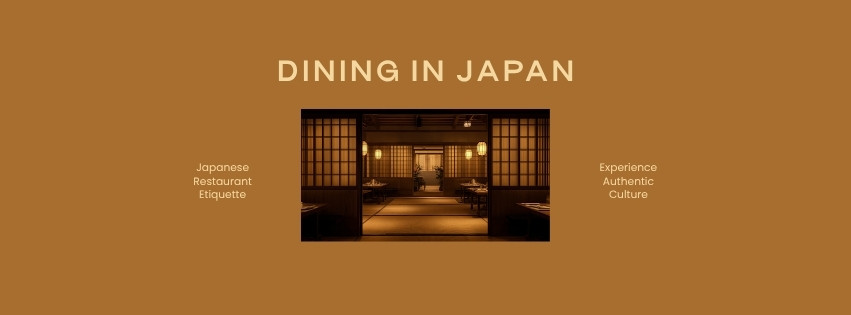
Walking into a Japanese restaurant for the first time feels different from dining out almost anywhere else. There is a theatrical quality to it — the staff call out in unison when you enter, a hot towel appears within seconds, and the menu arrives in a format that may be entirely in Japanese. None of this should be intimidating. Japanese restaurant culture has well-defined rituals and expectations, and once you understand them, the experience becomes one of the most pleasurable aspects of travel in Japan.
This guide covers the full arc of a Japanese restaurant meal — from entering to paying — with specific attention to the customs and taboos that matter most to local diners. Knowing these rules will not just prevent accidental offense; it will help you appreciate why they exist.
1. Entering and Being Seated
Japanese restaurants operate on a clear entry protocol. When you walk in, wait at the entrance — do not seat yourself. A staff member will approach, greet you with "Irasshaimase (いらっしゃいませ)" (Welcome), and ask how many people are in your party. You can hold up fingers, or simply say "futari" (two people), "sannin" (three people), etc.
Some traditional Japanese restaurants — particularly those with tatami mat flooring or private zashiki (座敷) rooms — require you to remove your shoes before entering the dining area. A step or platform area (called the Genkan / 玄関) marks where shoes come off. Slip-on shoes make this significantly easier. Your shoes are stored in a provided rack or box, and you sit on cushions on the tatami floor, either cross-legged or in seiza (formal kneeling position). Seiza for an extended meal can be uncomfortable — crossing your legs informally is perfectly acceptable at most venues.
Within moments of being seated, a Oshibori (おしぼり) — a damp towel — will be brought to your table. In summer this is typically cold; in winter, warm. Use it to wipe your hands before the meal. Do not use it to wipe your face (though many Japanese diners do this informally — it is technically considered improper etiquette). After wiping your hands, fold or roll the oshibori neatly and place it back in its tray or on the table. This is not a napkin to keep on your lap during the meal.
2. Ordering: Calling the Staff and Reading the Menu
Calling a waiter in Japan is done by saying "Sumimasen (すみません)" — excuse me — at a moderate volume. You do not wave your arms, snap your fingers, or use a loud voice to get attention. A calm "sumimasen" directed toward any passing staff member is the correct approach. Many modern restaurants also have a button on the table (a call button) or a tablet ordering system where you can order entirely without verbal interaction.
Do not panic. Point-and-order works perfectly at most Japanese restaurants — staff are accustomed to tourists pointing at pictures or menu items. Many restaurants have plastic or wax food displays (shokuhin sample / 食品サンプル) outside the entrance showing exact representations of every dish. Photographing these and pointing to your phone inside the restaurant is a completely accepted approach. Google Translate's camera mode can translate menus in real time by pointing your phone at Japanese text — accuracy varies but is usually sufficient to understand dish categories.
At izakaya (Japanese gastropubs) and many traditional restaurants, a small dish called Otoshi (お通し) — sometimes called Tsukidashi (突き出し) in Osaka — will appear unbidden at the start of your meal. This is an automatic small starter (a few bites of seasonal food) that comes with a small charge of ¥300–¥600 per person. It is not optional — it functions as a table cover charge. You cannot decline or send it back. Simply eat and enjoy it as an amuse-bouche.
3. Chopstick Etiquette: What to Do and Never Do
Chopstick etiquette is one of the most culturally significant areas of Japanese dining. Most rules have deep roots in Buddhist funeral customs, which is why breaking them feels genuinely transgressive to Japanese diners rather than merely rude.
1. Never stick chopsticks vertically into rice. This is done only when making offerings of food to the dead at Buddhist altars. Seeing this at a dining table is considered a terrible omen.
2. Never pass food from chopstick to chopstick. This mimics the ritual of passing cremated bones at a funeral. Instead, place food on a plate or saucer before offering it to someone.
3. Never use the tips you eat from to serve food from shared dishes. Turn your chopsticks around and use the clean upper end to transfer food from communal dishes to your plate — or use the serving chopsticks (toriwagebashi / 取り分け箸) provided for that purpose.
| Behavior | Acceptable? | Notes |
|---|---|---|
| Resting chopsticks on the edge of your bowl | Acceptable | Casual but fine. A chopstick rest (hashioki) is preferred when provided. |
| Spearing food with a chopstick | Avoid | Considered bad manners. Use a fork if struggling — staff will provide one if asked. |
| Pointing with chopsticks | Avoid | Gesturing with chopsticks is considered rude. Put them down before talking with hands. |
| Licking chopsticks | Avoid | Considered unsanitary and poor manners. |
| Using chopsticks as drumsticks | Avoid | Signals impatience and is disrespectful. |
| Holding bowl while eating | Acceptable | Holding rice bowls and soup bowls close to the mouth while eating is normal in Japan. |
4. Dining Customs and Food Etiquette
Beyond chopstick rules, several other customs define polite eating behavior at Japanese restaurants.
Two phrases bookend every Japanese meal. Itadakimasu (いただきます) — literally "I humbly receive" — is said before eating, hands pressed together, to express gratitude for the food and all who prepared it. Gochisosama deshita (ごちそうさまでした) is said after the meal to the staff when leaving — "it was a feast." Using these phrases as a non-Japanese visitor is always warmly received. You do not need to feel awkward about it; Japanese people appreciate the gesture enormously.
Slurping ramen, soba, or udon noodles audibly is not only acceptable in Japan — it is considered the proper way to eat them. Slurping cools the noodles as they enter your mouth, enhances the flavor by introducing air, and signals appreciation to the chef. The same applies to soup. Eating ramen silently in a perfectly polished manner is, ironically, the odd behavior at a Japanese noodle shop. Let yourself slurp.
5. Paying the Bill
Paying at a Japanese restaurant follows a different protocol from most Western countries. Understanding it in advance prevents confusion at the end of an otherwise pleasant meal.
When you are ready to pay, say "Okaike (お会計)" or "Okaike onegaishimasu" to the staff. Alternatively, make a crossing gesture with your two index fingers (forming an X shape) — this is universally understood as requesting the bill. In Japan, the bill is typically paid at the cash register near the entrance rather than at the table. The staff will bring a small tray with the total — place your payment on the tray (not directly into the cashier's hand) and change will be returned the same way.
Japan is significantly more cash-dependent than most developed countries. While credit card acceptance is improving rapidly in major cities, many traditional restaurants, small ramen shops, izakaya, and local eateries still operate cash-only. Always carry sufficient yen in cash — typically ¥10,000 per person per day covers both food and transport comfortably. Check whether a restaurant accepts cards when entering or before ordering at a cash-only venue — most display a small sign near the entrance or on the menu.
6. Common Mistakes to Avoid
A quick summary of the most common etiquette mistakes visitors make, beyond the chopstick rules covered above.
Do not move tables or rearrange furniture without asking staff.
Do not pour your own drink first — pour for others at the table first, then let someone pour for you (this applies particularly when drinking alcohol).
Do not start eating until everyone at the table has been served.
Do not leave food on your plate if you can avoid it — finishing your meal (especially rice) is respectful.
Do not talk loudly on the phone at the table — step outside if a call is necessary.
Do not take photos of other diners without permission — of your own food, freely.
Conclusion
Japanese restaurant etiquette is not a minefield of obscure rules designed to trip up visitors. It is a coherent system built on respect — for the food, for the people who prepared it, for your fellow diners, and for the staff. The rules that seem unusual at first (no tipping, no self-seating, the otoshi charge, the slurping) all make sense within this framework once you understand the underlying values. Learn a few key phrases, follow the staff's lead, say itadakimasu before you eat, and you will find that Japanese dining — at any price point — is one of the great pleasures the country has to offer.
Frequently Asked Questions
Is it rude to ask for a fork instead of chopsticks?
Not at all. Most Japanese restaurants that receive international visitors keep forks available. Simply ask "Foku wa arimasu ka?" (Do you have a fork?) or mime using a fork. Staff will provide one without comment. You will not offend anyone by eating with a fork — what matters is that you enjoy the food.
What should I do if I have a food allergy?
Japan has relatively limited awareness of Western-style food allergy management in its restaurant culture. For severe allergies (shellfish, nuts, gluten), carrying a written allergy card in Japanese is strongly recommended — services like AllergyEats Japan and SafelyEats offer printable allergy cards in Japanese. Note that soy, sesame, and fish products (dashi stock, bonito flakes, mirin) are used extensively even in dishes that do not appear to contain fish. Communicating severe allergies clearly in writing before ordering is the safest approach.
What does "last order" mean at Japanese restaurants?
Most Japanese restaurants stop taking new orders 30–60 minutes before closing time. This is called Last Order (ラストオーダー). Staff will come to your table to inform you. You can continue eating and drinking what you have already ordered, but no new items can be added. This is a common source of confusion for visitors who sit down at 9 PM at a 10 PM closing restaurant, expecting to order freely. When you see closing time on a restaurant listing, subtract 30–60 minutes to estimate last order time.
Can I split the bill between multiple people?
Splitting bills in Japan is less common than in many Western countries — the cultural default is for one person to pay the whole bill (often the most senior or the person who invited the group), with the understanding that it evens out over time. However, splitting the bill (warikan / 割り勘) is perfectly acceptable and increasingly common, especially among younger diners. Simply tell the staff you would like to split the bill before they calculate the total — saying "warikan de onegaishimasu" works. Splitting by item is unusual; splitting equally is the norm.